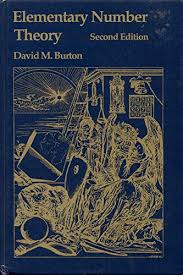
Elementary Number Theory (2nd Edition)
Quick Informations
Where to buy it: Amazon
Author: David M. Burton
Release date: 1989
Language: English
Personal Progress: Read completely
Description
This book presents all of the elementary theory of numbers starting from the very basic properties of divisibility to more advanced topics, such as representation of integers into sums of squares or solutions to Pell's equations. Many important topics are mentioned, such as modular arithmetic, prime numbers, primitive roots, the law of quadratic reciprocity, etc. The structure of the book is standard: thirteen chapters, each divided into four or five sections. The book is self-contained.
Review
Overall, I think that it is an excellent textbook to learn the subject. This book is perfect for people with little mathematical background, interested in number theory. The proofs and concepts are very well motivated and explained.
After the other textbooks I read, I felt like this book was maybe a little bit too easy (I read it at the end of my undergraduate studies). I decided to keep reading it, even if this feeling never left. I have this feeling because some entire secions can be dedicated to a very simple theorem or definition, and so I feel like the book is really taking its time to present the subject. In the end, this is not a bad thing because it lets the reader think about these simple ideas while solving the exercises.
It is important for me to warn the reader that the early editions (such as the one I used) contain errors, especially in the proof of the most important theorem of the last chapter (which was completely rewritten in the latter editions). This is not a big problem most of the times but it can be if you can't access the latter editions easily and make the comparaison to see if there was an update.
If I could change something in this book, I would put the last chapter on continued fractions and Pell's equation after the second chapter on divisibility and linear diophantine equations. This comes from the fact that none of the material of the book that comes after the second chapter is useful for the last one. Moreover, most of the topics in this last chapter perfectly deepen the ones introduced in the second one: continued fractions for rational numbers are simply another way to express the Euclidean algorithm and they lead to another way of solving linear diophantine equations, infinite continued fractions lead to solving homogeneous diophantine equations of degree two. Finally, even though the proofs in the last chapter were a little bit more involved, the exercises were mostly computational and easier than the other ones in the book
Exercises
There is a decent amount of exercises after each section (around fifteen). Some of them are simply computational, and others are more theoretical. For me, the exercises were very easy, but still useful to get familiar with the material. Concerning the computational exercises, most of them can be done really easily using a calculator, or a computer program. It is for this reason that I chose to solve all the exercises in this textbook by hand only. This increases the difficulty because it forces me to use what the author wants me to use, and it lets me practice computations by hand.
There is one big problem with the exercises: whenever an exercise becomes more than just applying a theorem from the section, a hint is given directly after the statement of the exercise. This is a problem because it is hard to avoid reading them, but also because some hints give a nearly complete solution of the exercise. I try to not read them whenever I can, but it is difficult. For me, this makes the book way too easy, in an unproductive way.
Prerequisites
This book has no prerequisites except being familiar with general school mathematics. However, I would say that reading a book on proof techniques first would help. For example, it can be useful to read the first two chapters of the book A Transition to Advanced Mathematics first.
Further Readinds
Clearly, this book opens the doors of many subjects. For example, elementary number theory is very useful to motivate most of the undergraduate level of abstract algebra (groups, rings, ideals, ...). Thus, a good follow-up to this book would be Abstract Algebra by Dummit & Foote. I didn't read books on these subjects yet but I would say that following this book with one on Analytic Number Theory can be a good idea (assuming the reader is familiar with classical analysis). The same is true for Algebraic Number Theory, but I feel like the latter requires more background.
Finally, if one wants to know more about the historical aspects of the subject, the perfect book to read would be Number Theory: An approach through history From Hammurapi to Legendre by André Weil.