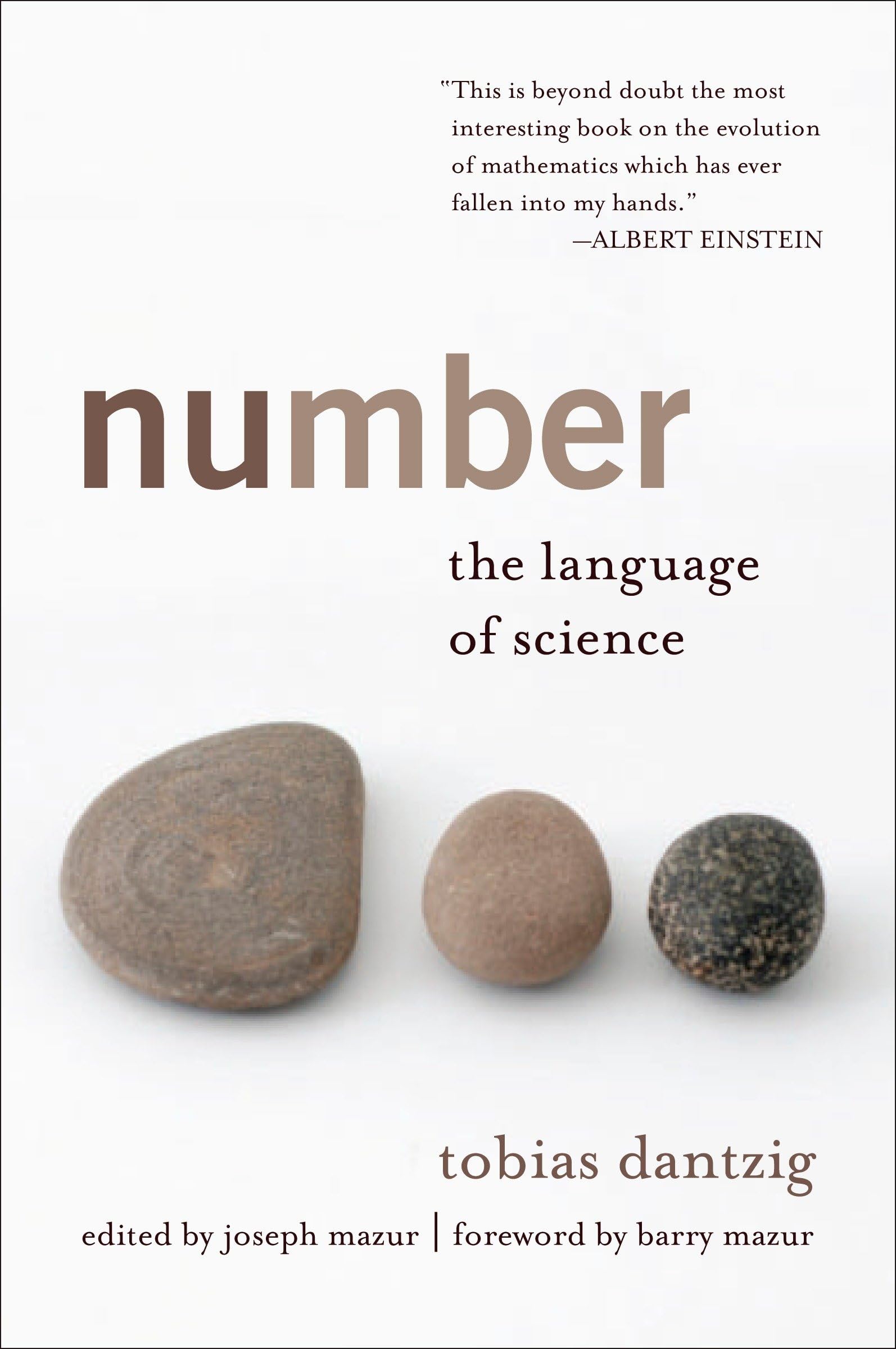
Number: The Language of Science (Masterpiece Science Edition)
Quick Informations
Where to buy it: Amazon
Author: Tobias Dantzig
Release date: First Edition: 1930, Masterpiece Science Edition: 2007
Language: English
Personal Progress: Read completely.
Description
This book is divided in two parts: the main section and the appendices. The main part presents the story and evolution of the concept of a number starting from the prehistorical period. As a corollary, we also get a more general history of mathematics. The appendices go much deeper into the actual mathematics. It mentions theorems and ideas from various mathematical fields, such as number theory, set theory or algebra.
Review
At first, I really loved reading this book. It was the first time that I read a book which talks about the more philosophical aspects behind the evolution of mathematical concepts. It is also the first time that I realized how much non-obvious are certain things we learn since primary school, or even before: counting, expressing numbers in the decimal system, the concept of a number by itself. The first half of the main section is full of very interesting reflections around these topics.
However, there two things I didn't like about the second half of the main section. First, I already knew most of the historical content of the second half of the main section, and so I was a bit bored. Secondly, I didn't really understand the philosophical part of this second half, especially questions about the reality. It may come from the fact that I am not used to read books on such topics, but I really didn't get most of that part, especially the last chapter which is entirely focused on reality. I am not saying that I didn't understand it, I am just saying that I didn't "get it". Reading the last chapter was like reading a bunch of well phrased sentences that, together, don't form a clear message or idea. I don't see exactly what the author was trying to say with the last chapters. Again, this may completely come from me, but I didn't really like the end of the main section because of that.
Concerning the appendices, I feel like knowing a lot of mathematics might be a bad thing when reading this part because it goes deeper into mathematical concepts that you already know. Everything is explained as if you never studied mathematics. It may not seem like a problem since appendices are usually optional, and made for people that don't know some concepts important to understand the main section, but this is not the case here. The appendices were originally considered as "Part 2" of the book, not something optional, and the content of the appendices is not required at all for the main section. Again, the appendices take around a third of the book.
To conclude this review, I would say that this book is really good for people that don't know much about mathematics, but not that much for people that are already deep in their mathematical studies. There are a lot of new and interesting ideas in this book, even for people in my situation, but it is filled with long explanations of very basic ideas. I did like this book, but only the first few chapters.
Prerequisites
There are no prerequisites. Anyone interested in mathematics or science in general can read this book.
Further Readings
I wouldn't be able to recommend any further readings for the moment.